It was the best of times, it was the blurst of times. Kids who grew up in the 90s manga boom weren’t old enough to get scanners and the like, so the first webcomics were Newspaper comics based on nerdy things.
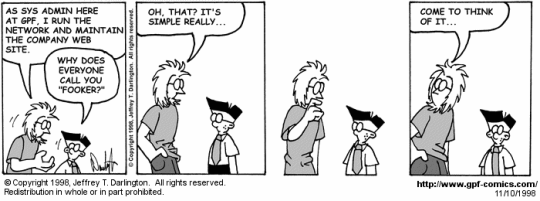
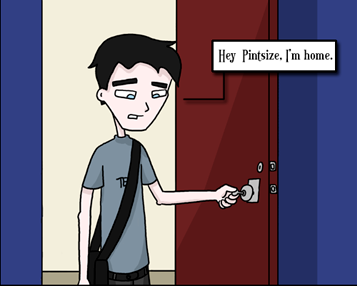
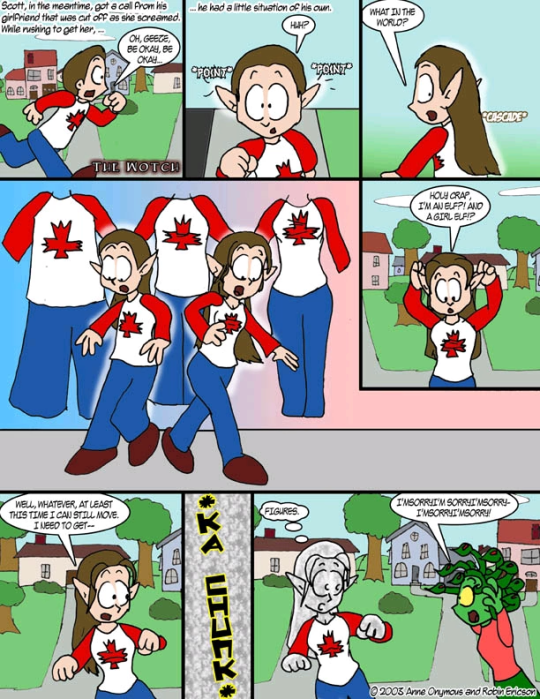
Like General Protection Fault, which was an even nerdier version of Dilbert.
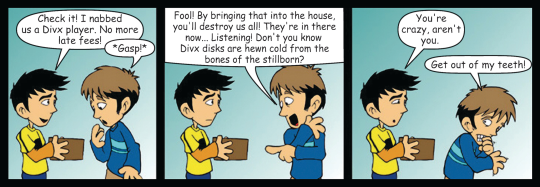
And, of course, 1999′s Penny Arcade. Penny Arcade’s success would inspire a million “two dudes on a couch playing video games” clones.
A dude saw Penny Arcade and convinced his artist friend to make a comic with him. He wanted a standard 4-panel comic just like in the newspaper. But his friend was a huge weeb, and wanted to have four vertical panels like in Japanese 4koma comics. So they found a compromise format and started a comic in 2000.
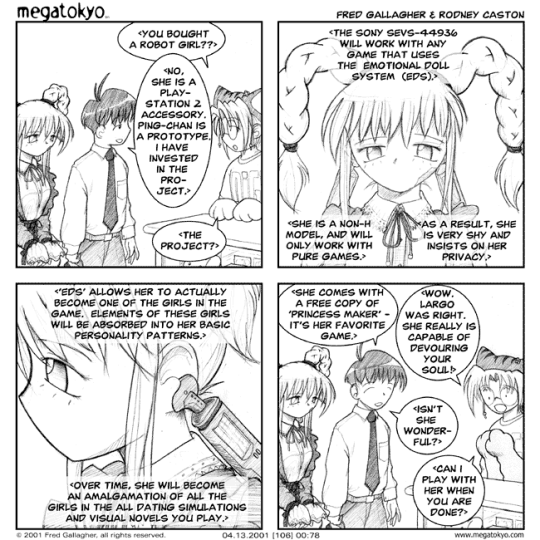
Megatokyo had a lot of video game jokes early on, but quickly morphed into being about anime stuff, which happened to be pretty popular. In lieu of video game jokes, it introduced some light sex humor, a woman with huge boobs who wanted to fuck the gamer dude, and a sentient android that everyone accepted as normal because it was a silly comic and a lot of early-2000s internet humor tended towards randomness.
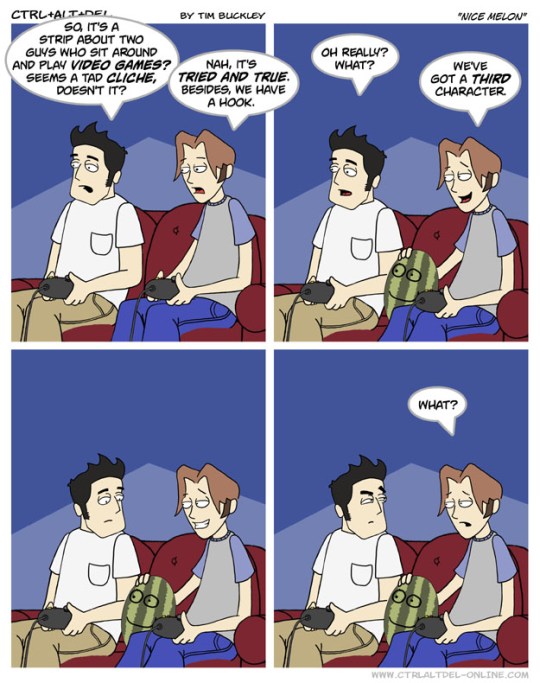
So you had these two really popular webcomics with elements that had obvious appeal: Dudes on a couch playing video games, sexy chicks with huge boobs who wanted to bang the MC, robots, and a weird square format that happened to be easier to read at lower resolutions. But could these elements be combined? One man dared to dream they could. And in 2002 he made his dream a reality
Given what a joke it’s rightfully since become, I feel the need to emphasize that CAD was one of the big early webcomics, and helped inspire it’s own share of imitators. It’s probably fair to say that it was more influential than even Penny Arcade, in that it had more elements that could be slavishly copied and passed around.
(If you ever wondered why it took so long for anyone in Questionable Content to acknowledge the weirdness of all the robots, it’s because random unexplained robots were really popular in webcomics in the early 2000s)
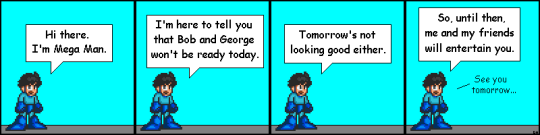
Meanwhile, it its own little isolated corner of the internet, Bob and George was popularizing “sprite comics”, a genre that consisted of itself,8-Bit Theater the next year, and a trillion shitty comics not worth mentioning. These were less influential than the Penny Arcade ==> Megatokyo ==> CAD ==> Questionable Content progression, but even this early the tiny webcomic scene was start to grow and split. Questionable Content was much more grounded than other webcomics at the time, and it’s rom-com plot was a big step away from the gag-a-day strips, but its influence was dulled because a bunch of other comics were starting to spring up. In the early 2000s, everyone was reading the same things because there were so few comics worth your time, but by the mid-2000s you were starting to see some quality.
You were also starting to see people getting serious about monetization. Scott McCloud’s dream of selling your comics for ten cents a pop and making bank in volume had crashed into the twin peaks of “most comics are also good and they’re free” and “credit cards charge fees, idiot”. Some of the better, more respected comics started joining together into one site with all of them that you needed to pay to access, kind of like how Slipshine works now except without the porn.
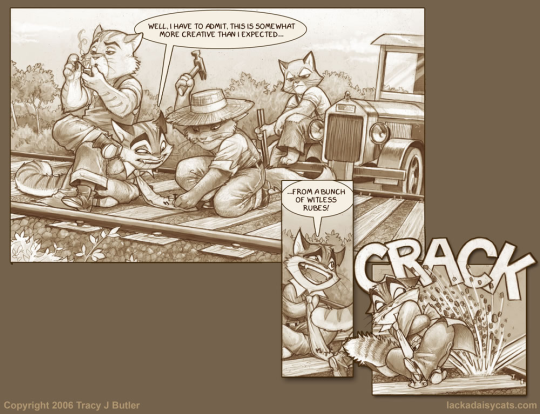
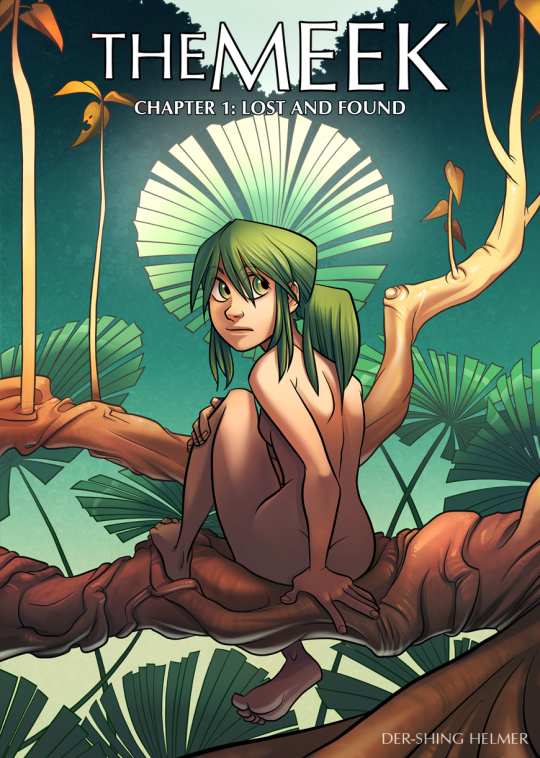
This didn’t work out financially, and it also meant that the best webcomics of the mid-2000s like Digger and Narbonic had really small audiences because you couldn’t read them without paying a fee first. Advertising was less useless then than it is now, but times were tough for the webcomics business in the pre-Patreon days. But some webcomics realized that they could find a profitable niche by appealing to new audiences. Instead of the straight white boys who made up the general webcomics audience, they’d reach out to a new demographic:
Perverts!
And, more specifically,
Furries!
Because furries really wanted furry content, and they were willing to pay for it. Pay a lot for it. Furry cheesecake comics prospered, and even though they didn’t have mainstream success, they were pulling it the big bucks compared to your average video game comic. People were starting to realize that 1000 hardcore fans was better than 100,000 casual fans, and a lot of comics started searching for a niche. (This is kind of related to webcomics becoming more progressive/inclusive a bit later, but that’s a whole ‘nother essay that I’m not the one to write)
These webcomics were pretty tame PG-13 stuff like you’d see in the shounen manga its creators were fans of, with nary a nipple to be seen, and a lot of them would die out in favor of straight-up porn.
In the late 2000s, art students realized that making a webcomic was a great way to build a portfolio, and we were hit with the Great Boom Of Webcomics By People Who Can Actually Draw. In 2003, that TwoKinds art was not only acceptable, it was top-tier for a free comic
By 2006 it was not the top tier
By 2008 it was no longer acceptable.
The world of webcomics became flooded with high-quality work by actual artists who’d gone to school and everything. The first generation of webcomics creators no longer ruled as the comics everyone read. Doctor Fun, the first-ever webcomic, ended in 2006. So did Narbonic and Mac Hall. Applegeeks, one of the most successful PA clones, ended in 2010 alongside 8-Bit Theater. Ctrl+Alt+Delete ended and rebooted to the interest of no one.
While in 2001, a bad artist could build a following just by updating regularly and slowly improving, that became a lot harder to do as the Bush Administration ended. There were too many brilliant artists making great content for someone to break onto the scene with simple art or sprites. And one day a lot of people gave up on ever being able to make a successful webcomic if their panels didn’t look like a magic the gathering card.
And it just so happened that that day, the 13th of April 2009, was a young man’s birthday…
No, that’s mean, I know you’re serious. It’s just flabbergasting how much fandom has expanded and how much there isn’t a direct link to the past.
Astolat and Cesperanza floated the idea at Vividcon and various places, I think, though I wasn’t going to cons in that era. We were all on LJ in those days, and Astolat made a big post nailing her theses to the door. Discussion in the comments was instant and prolonged.
A LJ com was set up to discuss. It was later renamed to otw_news, but if you go all the way back to the beginning, you can see brainstorming mess instead of official news posts.
Fun fact, we never intended to call it AO3. There was a whole call for name suggestions, but nothing was as evocative as astolat’s original post title referencing Virginia Woolf. (For those who haven’t thought about it, AO3’s name is a reference to A Room of One’s Own.)
That’s how many people cared at the time: a few hundred. Maybe a thousand if you count lurkers, but frankly, that community was not as lurkery as now. It wasn’t just ten friends. It was a community effort. But what “our” community looked like at the time was vastly different. It was six degrees of Kevin Bacon astolat, not a vast sea of strangers like fic fandom on AO3 is now.
Here’s an early post suggesting we ban the under 18s from the site entirely. Pity we didn’t do so, given the rise of antis.
Here’s the invite to a fundraising party at astolat’s in NYC that following Halloween. I dressed as Amanda from Highlander, not very well.
You can tell we knew each other by looking at those comments on astolat’s initial post. You can also tell how discussion-based that part of fandom was back in 2007.
The way my tumblr is now with a ton of text, back and forth, and hopping around between threads of conversation, all featuring a consistent set of faces, is very much like LJ. Most of tumblr is not.
This is important info to put out there, and I constantly forget that “fandom” as it is now is nothing like the community we had then. This is a good resource for understanding what was going on with the creation of AO3 in particular, but it’s also a great example of why older fans say that we miss the Livejournal era of fandom so much.
AO3 is the result of long discussions, hard work, and a dedicated community of fans. Though it isn’t is a social media site (and it was never intended to be), it is the only place now that sometimes feels like how the fannish community used to be on LJ–when a good discussion gets going in the comments on a story. But AO3 is for fanfiction et al, and therefore is limited in discussion subjects.
(The ads you’ll encounter if you follow those links, though? Did not exist when we were there and were one of the reasons we abandoned the site–not the most important reasons by a long shot as you’ll understand if you read more about why AO3 was created, but they were a factor.)
We were a collection of communities, with some-to-significant overlap in members. Fanfiction writers were not “content creators,” and people who didn’t write fanfiction were not “the lucky audience who should be soooooooooooo grateful that writers deigned to gift us with their incredible talent.” We knew each other. Many of us met each other IRL after meeting through fandom (once fandom shifted to the internet there was some hesitancy at first about meeting “online” friends, but that was quickly gotten over). We went to conventions together. We had lunch and dinner and parties and meet-ups IRL outside of conventions.
If you take a wander around from even just that one LJ community (click on a username to check out their personal LJ), you can see how discussions would branch off without excluding anyone the way they do on Tumblr. If you wanted to share something you saw on someone else’s LJ, you just linked to it, and people followed the link to read it and join in the discussion (or just lurk). The force of Tumblr splintering is an active barrier to creating real communities.
I really miss LJ. I miss the connection I felt to my community there.
Showing my age here, but one of the things I really miss was going to conventions like MediaWest and putting faces to names. I met and befriended so many brilliant, talented people there, and we got up to a ton of mischief together.
There were the post-art auction zombie walks across the street to Denny’s. There was the gathering in someone’s room where I performed a Patrick Stewart-style reading of a poem that featured Picard and Riker debating the merits of kinky sex. And if I’m recalling correctly, that get-together culminated in a thrilling luggage cart race down the halls.
There was a joke con flyer featuring “Men in Fandom—they’re both here and ready to talk”. Kevin Parker and I proudly offered to take the roles on. I did a hell of a lot of networking, too—getting editors’ names for submissions as well as culling for writers and artists for my own zines.
Sadly, we had to give a lot of that up when Darling Daughter came around and our disposable income had to go for more important things. But man, those were incredible times and I cherish every single memory.
I made it to MediaWest just once, long after its heyday. Still an interesting experience though.