I can never decide if posts like these sound more like the shitty, tacked on moral at the end of an 80s cartoon, or more like a child who found out some people like broccoli on pizza.
Anon, you have to understand that not everyone’s experience is the same as yours. That includes the experience of CSA victims.
There are many CSA victims who find healing and empowerment in writing about their experiences through fiction.
When you’re writing, or reading fiction, you are always in control of the scenario. There is never a moment where the situation is out of your control.
It can be a kind of exposure therapy, re-framing your abuse, an reclaiming power in a powerless situation.
You’re allowed to find that “fucked up” but people are also allowed to do “fucked up” things. Everyone’s boundaries are different.
Writing about something doesn’t cause it to happen. Reading about something doesn’t mean that you want it to happen. Bringing sex and sexual harm into the equation in fiction doesn’t change that.
Fictional characters aren’t real people. They can’t be harmed by writing about situations that would be harmful to a person in real life.
But real people can find healing through fiction about harmful things.
Its okay if you can’t, anon, but you have to understand that not everyone has the same experiences or reactions to trauma.
A treatise on the most poorly-remembered show of the 80′s
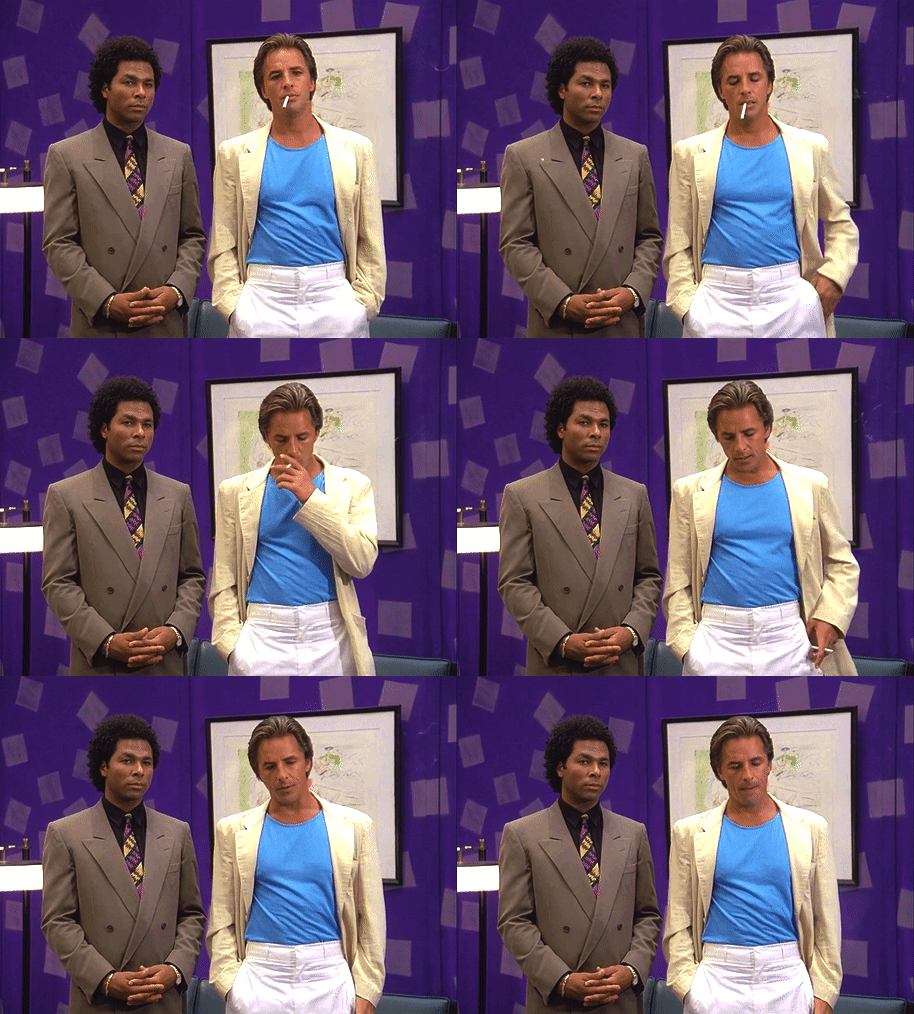
If you’re like most people, when you hear Miami Vice outside the context of a bar, you picture the following: shoulder pads, speed boats, bikinis, and pink and teal pastel. You probably think about the worst excesses of the 1980′s, of a kind of cultural sinkhole where there was nothing cooler than Ray-Bans and masculine posturing.
However, much like Captain Kirk is (mis)remembered as a sleazy womanizer, and the first Rambo movie is (mis)remembered as a paean to how AWESOME KNIVES ARE, Miami Vice has been frozen in pop-culture memory as something it really isn’t. A funhouse mirror reflection of what it was actually all about. Because the thing is: Miami Vice is good. Like, really good.
At its core, it’s a show that is:
Well-written, with a coherent emotional and thematic arc across its seasons, despite being made before the era of arc-based TV
Incredibly beautiful, with cinematography, directing, and musical/sound editing choices that literally changed the way television was produced
Deeply, sometimes painfully human, with main characters who are often wrong and/or make bad decisions with real consequences, and who often ‘lose’
And on top of that, it’s not really copaganda (no, really), and it’s pretty damn queer (yes, really.) It’s also an old-school episodic show, which means the characters have a ton of space to breathe and grow and be multi-faceted, and the production has room to experiment, both with technical stuff and the writing. There are episodes that are so deadly serious your mouth feels dry as the credits roll; there are weird, silly, fun episodes where utterly bonkers things happen; there are episodes that feel like David Lynch was moonlighting as director. It’s neo-noir, it’s magical realism, it’s a workplace comedy, it’s a treatise on how there’s no reforming unjust systems, it’s a love story about two men who refuse to grapple with the idea that they’re the most important thing in each other’s lives.
You should watch it. But let me keep trying to convince you, anyway.